


Archive for "Web"
The Birth of a Sports Hero
Posted on December 7, 2008 by Ching under News, Web.
Congratulations to Manny Pacquiao on his win against Oscar De La Hoya during HBO’s Dream Match yesterday, December 6. He is an inspiration to Filipinos everywhere. Talk about changing your stars!
PACQUIAO LINKS:
- PACLAND – Official Web Site
- Manny Pacquiao on Wikipedia
- Pacquiao Video Collection
- Pacquiao Bio on HBO Boxing
- Pacquiao Fan Web Site
- Another Pacquiao Fan Site
- Nike’s Manny Pacquiao
NEWS COVERAGE:
- Smaller Pacquiao Topples De La Hoya (NY Times)
- Analyzing Pacquiao’s victory over De La Hoya (LA Times)
- Pacquiao too fast, too strong in lopsided win (SF Chronicle)
- De La Hoya-Pacquiao round-by-round (USA Today)
- Pacquiao stuns “Golden Boy” De La Hoya with TKO (Reuters)
Click here for videos on Google!
No Comments

Recap of Our First Day
Posted on October 27, 2008 by Ching under Poker, Travel, Web.
This is the worst cruise ever! There is no internet service. Ugh!
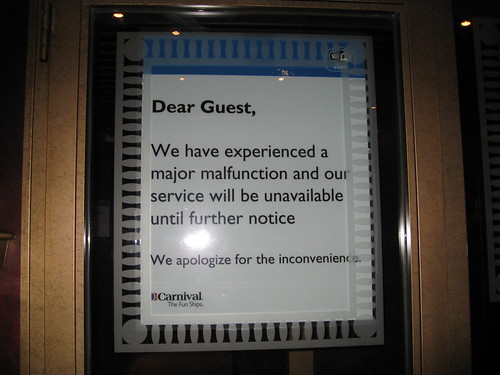
Just kidding! This isn’t the worst cruise ever. The part about having no internet is true, though. Brian and had planned on buying several minutes of internet service when we got on board. We stopped by the internet café a couple of times yesterday and they were closed for maintenance. We came by again today hoping to find things up and running, and also speak with someone about getting wireless internet, but they were still closed. This time there’s a sign that says they have experienced a malfunction and their services will not be available until further notice. Boo!
Anyway, I would have blogged yesterday but we were super tired. We had a really long day. As you know we all drove to Conroe, Texas (about an hour from the Houston port) on Saturday. The drive itself was pretty uneventful except for running into a place that sold “diet ice” (we scratched our heads at that one) and a gas station that had a high-tech Dyson hand dryer thing that had Brent totally amazed. We passed the time by playing my movie game and also Brent’s “think while you drink” famous people game. We made a couple of stops and before you knew it, we had arrived at the Baymont in Conroe.
We bunked with Dan and Brent that night. It wasn’t too bad except for the very disturbing sight of Brent and Dan spooning. I’m kidding!
Seriously, though, I think they had it worse because I snore — or so Brian says anyway. He did his fair share of snoring, mind you. Brian was prepared, though. He brought ear plugs. Brent had sleeping pills. Poor Dan had nothing. =P He was up at 6 AM, a good hour before our wake up call.
We got up that morning bright and early and were on our way ahead of schedule. We arrived at the port with no problems and, aside from some minor snags, embarkation went pretty smoothly. We did wander around the ship for a while before we found The Gallery, though. The Gallery is what the conference room where we are having the poker events is called.
Registration went slow at first, and then we got a whole mob a while after Kurt, Kathy, Shane, and Jen took off. Brent and Frank kept things in order, though. We had a good crowd going and even a few were came in as we were packing up. We had to shut down for the boat drill, my least favorite part of cruising. It gets so hot standing there with your life vest, shoulder to shoulder with a bunch of strangers. It couldn’t be over soon enough.
After the boat drill Brian and I had time to ourselves to do some exploring. We had dinner with the rest of the group and then we reconvened right after dinner to set up. Earlier in the afternoon we were talking about maybe not doing in poker that evening because we weren’t sure if the porters would come through for us. Naomi, the crew member who is assigned to our group, came through though. The six-foot tables were there and the chairs were set up around them. The porters delivered the table tops to the conference room as we had requested and all we had to do was take them out of their carry cases and put them on the tables.
We finished dinner right at 8 PM so we hardly had enough time to set up. A mob of anxious poker players had formed outside the room. Brian served as bouncer, keeping people out while the rest of us got the room ready. Kurt arrived before long with the important poker stuff. So much for not having poker and taking it easy on the first night. =P
We had four single-table sit-n-go (SNG) satellites and then a $1-$2 Texas hold’em cash game with a $50-min and $200-max buy in. I was at table 1 and started first. Brian’s table, table 2, started next but they actually finished last. Dan had a crazy table that finished way before everyone else. I hung around to wait for Brian when I got done. My table finished before his, but both of our tables took forever. Could be that we are inexperienced dealers. Who knows?
Anyway, it was about 1 AM when we were finally dismissed. What a long day! Needless to say, I was in no mood to blog last night. Today, I’ve had breakfast so my tummy is quite happy and I’ve got some time to kill so I figured I would take this opportunity to give you guys an update.
We are due back in the conference room a little after 11 AM to prep for today’s poker tournaments and cash games which will start at 1 PM. I will ask Kurt who the SNG winners were from last night so we can post the results on here. Stay tuned.
No Comments
Tentative Tournament Schedule for the 2008 Halloween Poker Cruise
Posted on October 26, 2008 by Ching under Poker, Travel, Web.
| DATE | DAY | TIME | EVENT | BUY-IN |
|---|---|---|---|---|
| 10/26 | Sunday | 8:00 PM | ST Main Event Satellites | $50 |
| 10/27 | Monday | 1:00 PM | ST Main Event Satellites | $50 |
| 4:00 PM | No Limit Texas Hold ’em | $60 | ||
| 8:00 PM | ST Main Event Satellites | $50 | ||
| 10/28 | Tuesday | 11:00 AM | $500 Freeroll | – |
| 1:00 PM | ST Main Event Satellites | $50 | ||
| 4:00 PM | No Limit Texas Hold’em | $60 | ||
| 8:00 PM | ST Main Event Satellites | $50 | ||
| 10/29 | Wednesday | 8:00 PM | No Limit Texas Hold ’em | $115 |
| 10/30 | Thursday | 8:00 PM | No Limit Texas Hold ’em | $48 |
| 10/31 | Friday | 8:00 PM | No Limit Texas Hold ’em | $60 |
| 11/1 | Saturday | 1:00 PM | Main Event | $440 |
| 6:00 PM | No Limit Texas Hold ’em | $115 |
NOTE: This is a tentative schedule and is subject to change depending on several factors. For example, the main event on Saturday could be divided into two sessions (with the first session starting in the morning) depending on the number of entrants. There will also be plenty of cash games in between tournaments (maybe even simultaneously). We will be offering Texas hold ’em, Omaha, Omaha hi/lo, seven card stud, and razz cash games all dependent upon player interest. Please be sure to sign the interest board.
2 Comments
How to Play Five Poker Variations
Posted on October 25, 2008 by Ching under Poker, Web.
We were told we’d probably get called to deal four different poker variations in addition to Texas hold ’em: Omaha, Omaha hi-lo, seven-card stud, and razz. Texas hold ’em is a game that Brian and I play all the time so we are quite familiar with it. The other four games, however, are somewhat foreign to us so I had to do some research. Anyway, I thought I would share what I learned with everyone.
How to Play Texas Hold ’em
Texas hold ’em is a community card game where players may use any combination of the five community cards and their two hole cards in order to make the best possible five-card poker hand. Hold ’em is usually played using small and big blind bets. The blinds are forced bets by the two players to the left of the button or dealer position. Blinds guarantee that there is action in every hand.
The small blind is posted by the player to the left of the button and is usually half of the big blind. The big blind is posted by the player to the left of the small blind. In tournament poker, blinds increase at regular intervals as the tournament progresses.
Each player is dealt two cards face down, with the player in the small blind position receiving the first card and the player in the dealer position receiving the last card. These cards are called hole or pocket cards.
The hand begins with a pre-flop betting round, beginning with the player to the left of the big blind (or the player to the left of the dealer, if no blinds are used) and continuing clockwise. A round of betting continues until each player has either folded, put in all of their chips, or matched the amount put in by all other active players. If all players call around to the player in the big blind position, that player may either check or raise.
After the pre-flop betting round, assuming that at least two players are still in the hand, the dealer deals three community cards face up. These cards are called the flop. Another round of betting follows. This and all subsequent betting rounds begin with the player to the left of the dealer and continue clockwise.
After the flop betting round ends, a single community card (called the turn or fourth street) is dealt. A third round of betting follows. A final single community card (called the river or fifth street) is then dealt, followed by a fourth betting round and the showdown, if necessary.
In all casinos, the dealer will burn a card before the flop, turn, and river. Because of this burn, players who are betting cannot see the back of the next community card to come, which might be marked.
If a player bets and all other players fold, then the remaining player is awarded the pot and is not required to show his hole cards. If two or more players remain after the final betting round, a showdown occurs. On the showdown, each player plays the best five-card poker hand he can make from the seven cards comprising his two hole cards and the five community cards. A player may use both of his own two hole cards, only one, or none at all, to form his final five-card hand. If the five community cards form the player’s best hand, then the player is said to be playing the board and can only hope to split the pot, since each other player can also use the same five cards to construct the same hand.
If the best hand is shared by more than one player, then the pot is split equally among them, with any extra chips going to the first players to the left of the button. It is common for players to have closely-valued, but not identically ranked hands. If the hand involves fewer than five cards, such as two pair or three of a kind, then kickers are used to settle ties. Remember that numerical rank is of sole importance and suit values are insignificant in hold ’em poker.
How to Play Omaha
Omaha is a community card poker game similar to Texas hold ’em, where each player is dealt four cards and must make his best hand using exactly two of them, plus exactly three of the five community cards. Omaha is a game of “the nuts” — the best possible high or low hand — because it frequently takes “the nuts” to win a showdown.
Although the betting rounds and the layout of the community cards are identical, there are two key differences between Omaha and Texas hold ’em:
- Each player is dealt four cards to his private hand instead of two.
- A player cannot play four or five of the cards on the board with fewer than two of his own, nor can a player use three or four hole cards to disguise a strong hand.
How to Play Omaha Hi-Lo
In Omaha hi-lo, each player makes a separate five-card high hand (traditional hand) and five-card ace-to-five low hand (eight-high or lower to qualify). The pot is split between the players with the high hand and the low hand. To qualify for low, a player must be able to play an 8-7-6-5-4 or lower.
Each player can play any two of his four hole cards to make his high hand, and any two of his four hole cards to make his low hand. Thus, the same player could hold both the best high hand and the best low hand. If there is no qualifying low hand, the high hand “scoops” (wins) the entire pot.
How to Play Seven-Card Stud
Seven-card stud is a variant of stud poker. Until the recent increase in popularity of Texas hold ’em, seven-card stud was the most popular poker variant in home games across the United States. This poker variation commonly uses antes and bring-ins.
An ante is a forced bet in which each player places an equal amount of money or chips into the pot before the deal begins. Often this is either a single unit (a one-value or the smallest value in play) or some other small amount. A percentage such as half or one-quarter of the minimum bet is also common. An ante paid by each player ensures that a player who folds every round will gradually lose money. This provides each player with an incentive to play the hand rather than folding when the opening bet reaches them.
A bring-in is a type of forced bet that occurs after the cards are initially dealt, but before any other action takes place. One player, usually chosen by the value of cards dealt face up on the initial deal, is forced to open the betting by some small amount, after which players act after him in normal rotation. Bring-ins are usually used in games with an ante. In seven-card stud the player showing the lowest card pays the bring-in.
In most fixed-limit and some spread-limit games, the bring-in amount is less than the normal betting minimum (often half of this minimum). The player forced to pay the bring-in may choose either to pay only what is required (in which case it functions similarly to a small blind) or to make a normal bet. Players acting after a sub-minimum bring-in have the right to call the bring-in as it is, even though it is less than the amount they would be required to bet, or they may raise the amount needed to bring the current bet up to the normal minimum (called completing the bet). For example, a game with a $5 fixed bet on the first round might have a bring-in of $2. Players acting after the bring-in can either call the $2, or raise to $5. After the bet is raised to $5, the next raise must be to $10 in accordance with the normal limits.
The game begins with each player being dealt two cards face down and one card face up. The player with the lowest-ranking upcard pays the bring-in, and betting proceeds after that in normal clockwise order. The bring-in is considered an open, so the next player in turn may not check. If two players have equally ranked low cards, suit may be used to break the tie and assign the bring-in.
If there is no bring-in, then the first betting round begins with the player showing the highest-ranking upcard, who may check. In this case, suit should not be used to break ties. If two players have the same high upcard, the player who is first in clockwise rotation from the dealer acts first.
After the first betting round, a burn card is dealt and followed by another upcard to each player (beginning with the dealer’s left as with all subsequent rounds). A second round of betting ensues, beginning with the player whose upcards make the best poker hand. Since fewer than five cards are face up, this means no straights, flushes, or full houses will count for this purpose. On this and all subsequent betting rounds, the player whose face-up cards make the best poker hand will act first, and may check or bet up to the game’s limit.
The second round is followed by a third upcard and betting round, a fourth upcard and betting round, and finally a downcard, a fifth betting round, and showdown if necessary. Seven-card stud can be summarized by the mnemonic two-four-one: two cards face down, four cards face up, one card face down. Upon showdown, the remaining players make the best five-card poker hand they can out of the seven cards they were dealt.
Note that there are only 52 cards in the deck, but seven cards to eight players plus four burn cards makes 60 cards. In most games this is not a problem because several players will have folded in early betting rounds. If few or none of the players typically fold because of the low stakes, you may want to limit the game to seven players. If the deck does become exhausted during play, previously-dealt burn cards can be used when only a few cards are needed to complete the deal. If even those are not sufficient, then a single community card is dealt to the center of the table on the final round (instead of dealing a downcard to each player). This community card is shared by everyone. Under no circumstances can any discarded card from a folded hand be “recycled” for later use. Unlike draw poker where no cards are ever seen before showdown, stud poker players use the information they get from upcards to make strategic decisions, and so a player who sees a certain card folded is entitled to make decisions knowing that the card will never appear in another opponent’s hand.
How to Play Razz
Razz is a form of stud poker that is normally played for ace-to-five low (lowball poker). The objective is to make the lowest possible five-card hand from the seven cards you are dealt. In razz straights and flushes do not count against you for low, and the ace always plays low. The best possible razz hand is 5-4-3-2-A, or 5 high.
Play is similar to regular seven-card stud. Razz is usually played as a limit poker game, meaning that there is a fixed amount that a player can bet per round. Each player antes and is dealt two cards face down and one card face up (also known as the door card). The player with the highest door card showing has to put in the mandatory first bet or bring-in, which is usually one third to half of the regular bet.
In a case where two people have a door card of the same rank, the bring in is determined by suit. Spades is the highest possible suit, followed by hearts, diamonds, and clubs. The king of spades would be the worst possible door card in razz, and a guaranteed bring-in. Play continues clockwise from the bring-in during each betting round, as in normal stud poker.
After the first round of betting, the remaining players are each dealt a card face up. Betting begins with the lowest hand showing. Play continues like this until the fifth card, at which point the betting increments double. The seventh card is dealt face down, and action would begin with the same player who opened on the sixth card. If more than one player remains at the end of the hand, there is a showdown. As with most forms of poker, the deal rotates to the left after each hand.
No Comments
Local WiFi 411
Posted on October 8, 2008 by Ching under Blog, Web.
Brian and I have a new web site! We started working on it last Sunday. It’s a community project, so please be sure to register and share any information you have. So far we only have a map of Wichita, but we should have more soon. Stay tuned!
Local WiFi 411
Things to do:
No Comments

